
Septic Tank Repairs
24/7, 365
Emergency call outs
No call out charge
1 Hour Response Time
Up To 10 Year Guarantee On ALL Repair Works
If your septic tank is leaking, backing up, or causing foul odours, the fix starts with the right diagnosis. We inspect the tank, inlet and outlet pipework, and the drainage field connection, then recommend the safest, most cost effective repair.
Contact Us Free
Common signs your Septic System needs repair
- Persistent foul odours indoors or around the tank area.
- Toilets or drains running slowly, gurgling, or backing up.
- Wet, boggy ground or pooling near the tank or drainage field.
- Unusual alarms or pump issues (where fitted).
- Cracked covers, damaged lids, or visible pipe defects.

Related Services
No Call Out Charge
What we can repair and what we check first
Septic tank problems are often caused by a small failure that triggers bigger symptoms. Before we repair anything, we confirm what is failing and why.
Tank components and connections
- Damaged baffles, dip pipes, inlet or outlet fittings.
- Leaking seals and joints at pipe connections.
- Faulty lids, covers, risers and access points (safety critical).
Pipework faults
- Blocked or collapsed inlet pipework.
- Root ingress, displaced joints, or cracked sections.
- Poor falls or settlement that causes recurring blockages.
Drainage field and downstream issues
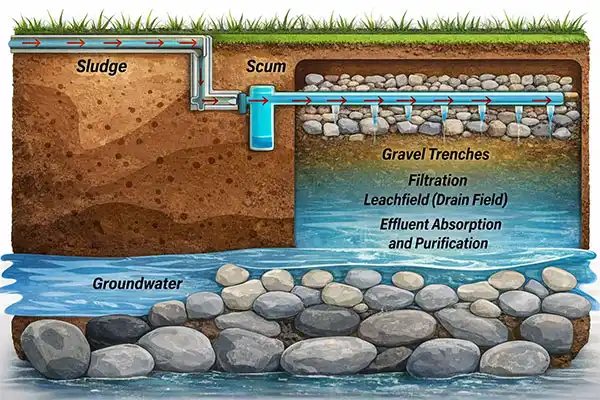
If the drainage field is saturated or failing, fixing the tank alone may not stop symptoms. We check for signs of waterlogging and backing up, and advise the right next step.
Emergency Septic Tank Repairs: What to do right now
If you have sewage backing up inside the property, act quickly to limit damage.
- Stop using water where possible (showers, washing machine, dishwasher).
- Keep people and pets away from any contaminated areas.
- Do not open covers unless you can do so safely.
- Contact us so we can prioritise attendance where possible.
For urgent situations and what to do first, use our Emergency page.
Our diagnosis to repair process

1) Quick triage (phone, message or email)
We ask a few practical questions and help you reduce risk until we arrive, especially if you have internal backups.
2) On site inspection
We inspect access points, check liquid levels, look for signs of leakage, and assess how the system is behaving today.
3) Pinpoint the cause
Where needed, we use inspection methods to confirm whether the fault is in the tank, the inlet or outlet pipework, or the drainage field connection. If you want a documented condition check before committing to work, see our Septic Tank Surveys and Inspections
4) Clear options and a written recommendation
You get a straightforward explanation of what is wrong, what we recommend, what is optional, and what can wait.
5) Repair and functional checks
After repair, we confirm flows and advise on correct usage and maintenance to help prevent repeat failures.
What Affects the Price of a Septic Tank Repair
Repair costs vary because the cause varies. These are the main factors that change the scope:
- Access and depth of the tank and pipework.
- In some cases, emptying is needed before inspection or repair for safety and clarity. See Septic Tank Emptying.
- Type of failure (component swap vs structural repair vs pipework replacement).
- Ground conditions and whether excavation is needed.
- Whether drainage field issues are involved.
- Any permissions, inspections, or compliance requirements for upgrades.
Repair vs replacement: how we help you decide
Sometimes a targeted repair is the right answer. Other times, the most sensible plan is replacement or conversion, especially when the tank is structurally compromised or the discharge arrangement is not compliant. We explain the trade offs in plain English before you spend money. If replacement or an upgrade is the more reliable option, you can read about the process on Septic Tank Installation.
Preventing repeat problems
Most repeat call outs come from avoidable causes: poor maintenance, misuse, or drainage field stress. We give practical guidance based on what we find on site, including sensible emptying intervals and what not to flush.
Common Questions
Septic Tank Repairs Frequently Asked Questions (FAQs)
Yes, but it depends on the tank material, where the crack is, and whether the structure is still sound. We normally start with a condition check so you do not pay for the wrong fix. If you need a formal assessment, see Septic Tank Surveys and Inspections. If repair would be unreliable, we will explain replacement options on Septic Tank Installation.
Not always, but many faults are safer and clearer to diagnose once levels are reduced. If emptying is required, we can advise the best timing and coordinate it as part of the job. You can also view our Septic Tank Emptying.
Emptying can reduce symptoms, but it does not fix broken components or poor airflow. Odours often point to damaged baffles, incorrect inlet or outlet fittings, ventilation issues, or downstream restrictions. If the smell keeps returning, a diagnostic visit is usually the quickest route. See Septic Tank Surveys and Inspections.
Not always. A backup could be caused by internal pipework, the inlet line, the tank itself, or the outlet side. The fastest way to stop repeat call outs is to confirm where the restriction is before any major work. If you have internal sewage backing up, follow our emergency guidance and contact us straight away.
We can assess whether your symptoms suggest drainage field stress or failure and advise the correct next step. In some cases a repair is possible; in others, a new solution is the sensible option. A proper assessment usually starts with Septic Tank Surveys and Inspections and, where needed, planning for upgrades through Septic Tank Installation.
Repairs can resolve faults, but compliance depends on the type of system and how it discharges. We can flag any compliance risks we see and recommend the safest next steps based on your setup. For compliance focused checks, start with Septic Tank Surveys and Inspections.
We prioritise situations with internal backups and clear health risks. Availability depends on location and existing bookings. If it is urgent, use our Emergency page and contact us with your postcode and symptoms.
We cover Dorset, Hampshire, Berkshire, Wiltshire and Somerset. You can confirm coverage on our Areas page and then book through Contact.