
Septic Tank Installation
24/7, 365
Emergency call outs
No call out charge
1 Hour Response Time
Up To 10 Year Guarantee On ALL Repair Works
If your property is not connected to the mains sewer, a properly designed septic tank system is essential. Whether you are installing a new system or replacing a failing tank, the right setup depends on ground conditions, access for machinery, and how your discharge will be managed.
Contact Us Free
Septic System Installation
If your property is not connected to the mains sewer, a properly designed septic tank system is essential. Whether you are installing a new system or replacing a failing tank, the right setup depends on ground conditions, access for machinery, and how your discharge will be managed.
Talk to us to arrange a site visit and get a clear recommendation for your property.
Do you need a new septic tank or a replacement?
Most customers come to us for one of these reasons:
– A septic tank is cracked, collapsed, leaking or no longer structurally sound
– The system is backing up, overflowing or producing persistent odours
– The drainage field or soakaway has failed and needs redesigning
– A property is being renovated, extended, or the occupancy is changing
– A new build or rural property needs an off mains wastewater solution
If you are unsure whether you need a full replacement, we can assess the system and explain the most sensible options.
Other Septic Tank Services
No Call Out Charge
What Affects Septic Tank Installation Cost?
Every installation is different, but the main cost drivers are usually:
Access and excavation
Tight access, long runs, deep digs, tree roots, or the need for specialist machinery can change the scope.
Ground conditions and drainage field requirements
Clay ground, high groundwater, limited space, and marginal infiltration often require a more engineered solution.
Removal of an old tank and reinstatement
Replacing an old system can include safe removal, making good, and reinstatement of gardens, driveways or hardstanding depending on where the tank sits.
We will only quote after understanding the site, because guesses are rarely helpful in off mains work.
Our Septic Tank Installation Process
We keep the job straightforward and transparent, with a clear process from survey to commissioning.
Our Septic Tank Installation Process
1) Site visit and assessment
We start with a practical site assessment to understand:
– Where the existing system sits (if there is one)
– The available space for a tank and drainage field
– Access for excavation and delivery
– Ground conditions and likely infiltration performance
– Any obvious risks such as high water table, clay ground or restricted access
2) Sizing and system selection
Septic tanks are not one size fits all. We size and plan the system based on occupancy, usage patterns, and the space available for infiltration.
If a sewage treatment plant is more suitable than a septic tank for your discharge route or site constraints, we will explain why and what that means in practice.
3) Approvals and compliance guidance
Rules and approvals can vary depending on the discharge route and your local authority. We will explain what may apply and what information you may need to provide.
For official guidance, you can also refer to:
– GOV.UK: Permits you need for septic tanks and sewage treatment plants
https://www.gov.uk/permits-you-need-for-septic-tanks
– GOV.UK: Approved Document H (Drainage and waste disposal)
https://www.gov.uk/government/publications/drainage-and-waste-disposal-approved-document-h
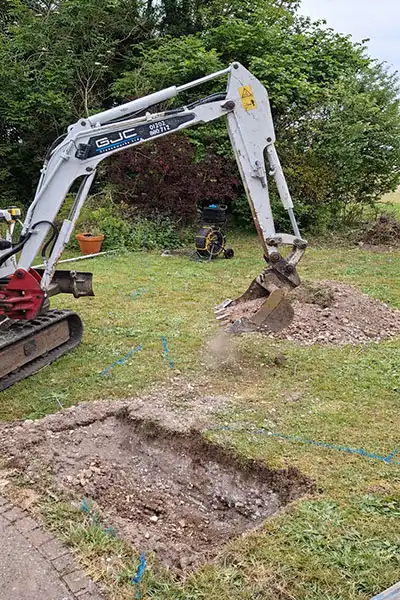
4) Excavation and installation
Once the plan is agreed, we carry out the groundwork, install the tank, and connect the pipework with the correct falls and levels. We work carefully around existing services and reinstate the area as agreed.
5) Drainage field and soakaway connections
A septic tank relies on effective infiltration. Where required, we install or rebuild the drainage field or soakaway arrangement to suit the property layout and ground conditions.
If you are replacing a tank but the soakaway is already failing, we will be honest about it. A new tank will not fix a failed drainage field.
6) Commissioning and handover
We test the system, confirm it is functioning as intended, and talk you through:
– What you can and cannot put into the system
– How to reduce the risk of blockages and premature failure
– What to watch for in early warning signs
– Typical maintenance expectations
Regulations, permits and Building Control
Septic tank and wastewater systems are subject to Building Regulations and environmental rules. In many cases you may be able to operate under the general binding rules, but some sites and discharge routes require additional steps.
We will explain what is likely to apply to your situation and what to check with your local authority where needed.
Why choose Septic Tank Solutions?
- Clear process from survey to commissioning.
- Advice based on real site conditions, not generic assumptions.
- Practical recommendations if a repair or soakaway work is the better solution.
- Tidy workmanship and straightforward communication
Common Questions
Septic Tank Installations Frequently Asked Questions (FAQs)
It depends on access, ground conditions, and whether a new drainage field is needed. After the site visit we can give you a realistic programme for the work.
Yes, if the existing infiltration arrangement is sound and suitable. If it is failing or undersized, replacing only the tank often leads to the same problems returning.
Yes, but treatment plants and septic tanks are not the same, so the approach and checks can differ. If you have a treatment plant, use the dedicated page so you book the right service on Emptying Sewage Treatment Plants
It depends on your discharge route, space, and site constraints. We will talk you through the pros and cons for your property, not a generic answer.
Sometimes. A new installation can involve planning considerations depending on your local authority and the nature of the work. A replacement in the same location may be treated differently. We will explain what to check and what information is normally required.
Most new or replacement drainage and waste systems will need to meet Building Regulations. We can guide you on what Building Control will typically want to see.
Many small discharges can operate under the general binding rules, but some situations require a permit. The discharge route and site sensitivity matter. We will help you understand the likely route for your property.